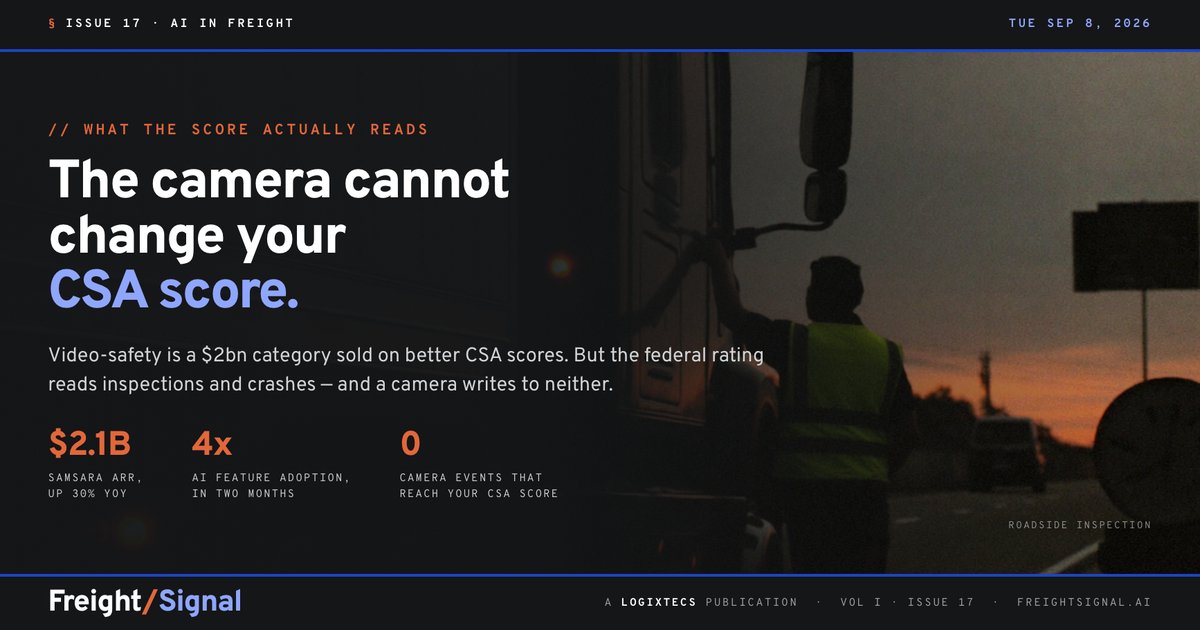
What the camera can touch, and what it can’tYour CSA score is assembled from two inputs: roadside inspection violations and DOT-recordable crashes. That is what Appendix B describes, and it is why the only events that move your score are events a government employee recorded. An in-cab camera produces neither. It produces a vendor’s score — proprietary number, proprietary scale, computed by the company selling you the camera. Useful internally. Invisible to FMCSA. So the chain from camera to CSA is one link long and slow: the camera changes behaviour, the behaviour prevents a crash or a violation, and the absence of that event stops making your score worse. You are not improving a score. You are declining to damage it, then waiting for the old damage to age out. The benefit that arrives fastest is the one vendors mention second: footage after a crash. When a four-wheeler brakes in front of your truck and the police report says otherwise, the video is the whole case. That is a litigation asset, worth buying on its own terms. “Getting better information is awesome, but now what? … AI can’t understand your team and your operation’s nuances.” Rustin Keller, CEO, J. J. Keller & Associates |
The camera generates events, and every event is a decision somebody makes and a conversation somebody has. A system that finds more problems than you have hours to address does not reduce risk — it documents it, in a timestamped record a plaintiff’s lawyer can subpoena. Keller sells advisory services, so read the remedy with that in mind. The diagnosis still holds. Read Part 385 → |