Who actually checked?
In nine days, four credentials in freight failed in public. A device listing. A commercial driver's licence. The identity behind it. The operating authority itself. Every one is the same object: a claim on a form, accepted first and checked later.
Next issue lands Tuesday at 06:00 CT.
Check your inbox — the welcome note has Issue 0, the MOTUS field guide.
Last week I promised you a deadline and a list of ten device names. Both are here, further down, and if that is all you came for you can skip to the section headed September 8.
But I went to count something first, and the count turned into a different piece.
The number nobody publishes
FMCSA maintains two public lists of electronic logging devices that are no longer valid: the ones the agency revoked, and the ones vendors withdrew themselves. What it does not publish — anywhere I can find — is a count. There is no annual figure. There is no trend line. There is a list of names, and the list only tells you the present tense.
We mirror those listings daily as part of the research backend behind this newsletter. On August 3 I pulled the whole history: 547 records, which deduplicate to 275 unique device listings, because the scraper captures the same pages every morning.
271 of the 275 carry a date. Sorted by year, the ones FMCSA initiated look like this:
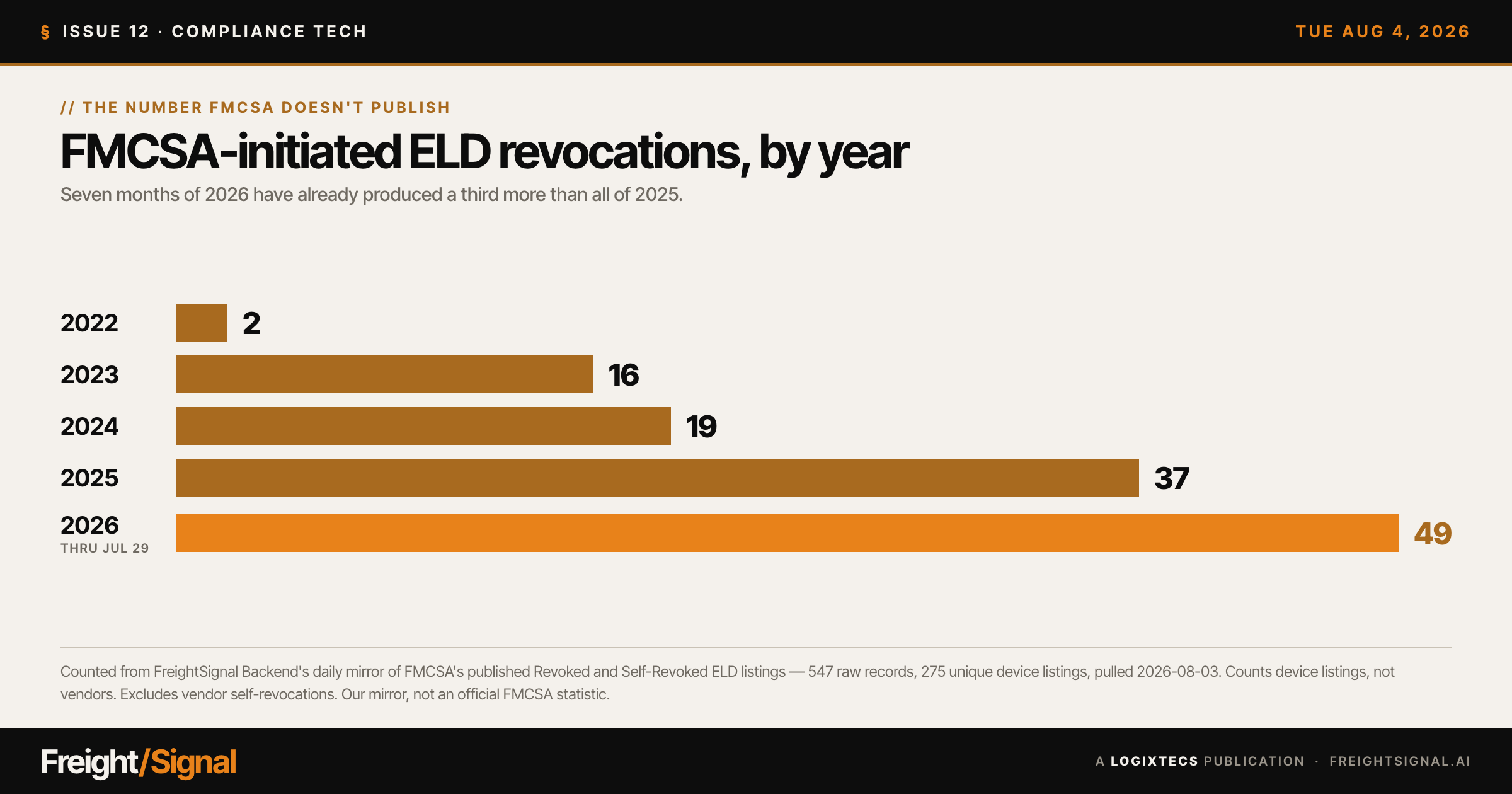
| Year | FMCSA-initiated | Vendor self-revoked | Total |
|---|---|---|---|
| 2022 | 2 | 20 | 22 |
| 2023 | 16 | 43 | 59 |
| 2024 | 19 | 21 | 40 |
| 2025 | 37 | 21 | 58 |
| 2026 (through Jul 29) | 49 | 16 | 65 |
Seven months of this year have already produced a third more forced revocations than all of last year. At this pace 2026 finishes around 84.
What the count is, and what it isn’t
I want to be precise about this before anyone quotes it, because I am about to correct my own previous number and it would be poor form to introduce a new one carelessly.
It counts device listings, not companies. One vendor can lose several products at once — of the ten devices revoked on July 9, two belong to the same company.
The pre-2022 rows are self-revocations only. That is not missing data; FMCSA does not appear to have begun forced removals until 2022. But it means the jump from 2 to 49 is measuring a programme that was starting up, not just a problem that was growing. Both things are true and only one of them is alarming.
It is our mirror, not an official statistic. FMCSA’s own site is unreachable to us — it sits behind Akamai and returns a 403 to our requests, which is a recurring nuisance in this job. The underlying listings were cross-checked against trade coverage from CVSA, The Trucker and Truckers News, and the independently reported lists agree with ours on the July 9 batch. That is corroboration, not an audit. If FMCSA publishes a number that contradicts this one, theirs is right and I will print the correction.
And a correction to make now
Issue #11 printed “FMCSA has pulled 79 devices since January 2025.” That figure came from trade coverage, and I passed it through without a way to check it.
My own count over the same window is 86 FMCSA-initiated revocations, or 123 counting the vendors who pulled their own listings. Close to 79, not the same as 79.
I do not think the difference changes anything an operator would do. I am printing it because a number you cannot show the working for is a number you should not have printed, and this newsletter has now published two original measurements in two weeks. The standard has to apply to both.
September 8
Ten devices were revoked on July 9. Carriers running them have until Tuesday, September 8 to move to a compliant device:
- Ontime Logs iosix
- LAST MINUTE ELD
- Porter ELD
- Zee HOS Compliance
- EV ELD IOSIX (formerly EVO ELD IOSIX)
- Light and Travel ELD
- PREMIERRIDE LOGS
- 2BRO ELD
- 305 ELD
- TT ELD 40
FMCSA’s stated deadline is September 8. A straight sixty-day count from July 9 lands on the 7th; use the agency’s date, not the arithmetic.
Until then, enforcement has been told not to cite drivers on these devices for having no record of duty status. After it, a driver running one has no record of duty status under 395.8(a)(1) and is not using a registered ELD under 395.22(a). That is an out-of-service order at the roadside. If you cannot get a replacement installed in time, paper logs are compliant and a revoked device is not.
The devices were removed for failing to meet the minimum requirements in Appendix A to Subpart B of Part 395.
The entry that changed how I read the list
The most recent record in the feed is dated July 29, and it is not a fly-by-night.
Geotab Drive for Platform Science — model PSG5000, ELD ID PG5000 — appears on the self-revoked list. Platform Science completed its acquisition of Trimble’s global transportation telematics business in February 2025. Its strategic investors include Trimble, which holds about a third of the company, along with Cummins, Daimler Truck, Paccar, Schneider, C.R. England, Prologis and Ryder’s venture arm.
Elsewhere on the same list: three J. J. Keller products, and ZED ELD from Zed Connect, a Cummins company.
Nobody did anything wrong. A self-revocation is a vendor voluntarily withdrawing a listing, and it usually means exactly what it sounds like — a product was discontinued, a version rolled over, a post-merger portfolio got consolidated. It is not an enforcement action and I am not going to write it as one.
That is the point, though, and it is a better point than the one I went looking for.
I expected the revoked list to be a story about bad vendors, and some of it is. But the operator consequence does not depend on the vendor being bad. If the device in your truck leaves the registered list, you have sixty days — whether it left because FMCSA pulled it or because a well-capitalised telematics company retired the SKU. The driver’s clock does not care why.
Which raises the question the rest of this piece is about: who was supposed to be watching?
Nobody certifies these devices
Here is the part most operators do not know, and there is no reason they would.
FMCSA does not test or approve electronic logging devices. Vendors self-certify that their product meets the technical specification, register it, and it appears on the list. The agency’s role is to remove devices afterwards, when it determines a listing was wrong.
So the list is not a certification. It is a registry of claims that have not yet been withdrawn.
Once you see it that way, the churn stops looking like a scandal and starts looking like a design. Forty-nine removals in seven months is not a system failing — it is a system doing the only thing it was built to do, which is clean up after the fact. The check was always downstream of the authorisation.
Now hold that thought, because the same design appears one layer up.
The same flaw, one layer up
Here is how a person becomes a federally authorised motor carrier today.
You apply for a USDOT number. On the MCS-150, you certify that you are knowledgeable about the applicable federal safety regulations. You receive New Entrant authority. You start hauling freight. And then, within eighteen months, someone comes to check whether the certification was true.
Certify first. Verify later. It is the ELD registry with trucks on it.
FreightWaves went through the history of the rule that would reverse that order, and it is a remarkable piece of institutional inertia. The New Entrant Safety Assurance Process — RIN 2126-AB17 — traces to the Motor Carrier Safety Improvement Act of 1999. The programme was established in 2003. The last major action was a final rule in December 2008. Advocates for Highway and Auto Safety petitioned in January 2009. An advance notice of proposed rulemaking followed in August 2009.
Then nothing, for more than fifteen years.
FMCSA now targets November 2026 for a supplemental advance notice. I want to be careful here, because it is easy to oversell: that is not a proposed rule. It is a request for information — the step before the step before a rule. Whether it goes anywhere is genuinely unknown.
What the courts did about it
While the registration side sat still, the liability side moved all at once.
On May 14, 2026, the Supreme Court decided Montgomery v. Caribe Transport II, LLC, No. 24-1238. The vote was 9–0. Justice Barrett wrote the opinion; Justice Kavanaugh concurred, joined by Justice Alito.
The question was whether the Federal Aviation Administration Authorization Act preempts state-law negligent-hiring claims against freight brokers. The district court said it did. The Seventh Circuit agreed. The Supreme Court reversed, holding that such claims fall within the statute’s safety exception — that requiring a broker to exercise ordinary care in selecting a motor carrier “concerns motor vehicles” and is therefore within the safety regulatory authority states retain.
For years, preemption let brokers end negligent-selection claims early, before discovery got expensive. That defence is gone.
What replaces it is your file. Whether you checked, what you checked, and — this is the part that matters operationally — when you checked it.
Ten weeks later, a Dallas County jury returned $604 million in Lipe v. Lupus Superior, against C.H. Robinson and a motor carrier, over a 2021 pileup on I-20 in Mississippi that killed three people. The carrier had a Satisfactory rating when it was hired and had run around 270 prior loads. Regulators had flagged it for unsafe driving more than a year before the crash.
C.H. Robinson said on July 29 that it is confident it will overturn the verdict on appeal, and has said it “should not be held liable and did not act negligently.” The case is being appealed and nothing here should be read as a view on the merits.
But look at what the file contained: a valid rating, a long clean history with that broker, and a regulator’s flag that pointed the other way. Every one of those is a credential. Two of them said yes.
The market read it immediately. C.H. Robinson’s second-quarter earnings call was taken over by the subject. Landstar reported a jump in brokers wanting to join its independent-agent network. Triumph Financial’s Aaron Graft argued that litigation, regulation and legislation now function as barriers to entry — one reason capacity is not flooding back into this cycle the way it has before. Werner’s Derek Leathers described structural capacity attrition “playing out as predicted.”
Vetting stopped being overhead. It became a cost of entry, which means it also became a moat.
What Congress did about it
On July 28, Senators Todd Young (R-Ind.) and Andy Kim (D-N.J.) introduced the Safety and Accountability in Freight Enforcement Act — the SAFE Act, S.5150 — the Senate companion to H.R. 7539, which arrived in February with nineteen co-sponsors.
The target is chameleon carriers: operations that shut down under enforcement pressure and reopen under a new name, new ownership structure, or new USDOT number. Data from Fusable, cited by 60 Minutes earlier this year, puts them at four times more likely to be involved in a severe crash. I have not seen Fusable’s methodology, so take that as attributed rather than verified.
Read what the bill actually asks for. FMCSA is directed to study the problem and to “plan, develop and test an advanced automation tool to detect chameleon carrier applications submitted for registration” — and to share what it finds with Homeland Security, Justice, Treasury, Commerce and State. Findings are due within a year of enactment.
ATA backs it. So does OOIDA — Todd Spencer said law-abiding small-business truckers “strongly support” it, which is not a sentence you see about most enforcement bills.
Here is why it belongs in a technology newsletter. The remedy Congress reached for is software at the registration gate. Not a bigger penalty, not more roadside enforcement — pattern detection applied to applications, before authority is granted. That is a tacit admission that the gate is the broken part, and that a human reading a form cannot tell the difference between a new company and an old one wearing a new name.
And the credential underneath all of them
None of this matters if the licence in the driver’s pocket is fiction.
On July 29, three people pleaded guilty in Louisiana to bribery concerning programs receiving federal funds. Mahmoud Alhattab, who ran a restaurant. Jonathan Parsons, who operated a truck-driver training business. And Marline Roberts, who was a skills-test examiner.
From August 2020 to February 2024 — three and a half years — the scheme ran out of the Donaldsonville Office of Motor Vehicles. At least 124 people received commercial driver’s licences with no training and no test, paying about $5,000 each. Sentencing is set for October 28; each faces up to ten years.
I do not know where those 124 licences are now. The reporting does not say whether the holders have been identified, whether the licences have been revoked, or whether any of those people are driving today. I am not going to guess in either direction. The absence is the finding: a credential can be manufactured at industrial scale for three and a half years, and the public record of the prosecution does not tell you what happened to the output.
Then there are the identity cases. Transport Topics collected three federal prosecutions involving stolen identities used to obtain CDLs. Read how each one surfaced:
- A man holding a Kentucky CDL under a stolen Puerto Rican identity was found because a probation officer noticed a second person using the same Social Security number in Ohio.
- A man with a fraudulent Texas CDL working in South Dakota was caught when he was stopped for speeding in Oklahoma and a search turned up two false IDs with his photograph.
- A woman holding a Connecticut CDL on a stolen identity surfaced when the real person applied for Social Security disability benefits and was told someone else had been working under his number.
A probation officer. A traffic stop. A benefits application.
Not one of the three was caught by the system that issues, renews, or verifies commercial driver’s licences. They were caught by accident, by unrelated parts of government bumping into the discrepancy. If that is the detection mechanism, then the number of cases we know about is a measure of how often people get unlucky, not of how often it happens.
The vendor layer, reported flat
One more thing, and I am going to state it carefully because it involves an untested allegation against a named company.
On July 25, Motive published an explainer on what Montgomery means for carrier vetting. It is a reasonable piece of content marketing about a real problem.
On July 24 — the day before — truck drivers Adam Dean and Christian Erickson filed a class-action complaint against Motive Technologies Inc. in the U.S. District Court for the Northern District of California. The complaint concerns the automatic licence plate readers built into Motive’s AI dash cams, and alleges that the company collected vehicle images, plate numbers, time-stamped location data and biometric identifiers without consent, and failed to post policy information the law requires. It cites California Civil Code § 1798.90.5, the state’s ALPR statute, and seeks $2,500 per class member plus punitive damages and an injunction. It puts Motive’s footprint at roughly 100,000 customers and 1.3 million drivers.
These are allegations in a filed complaint. They have not been tested. I looked for a response from Motive and did not find one, which means only that I did not find one. I am not drawing a conclusion about the company or its intent.
I am including it because of what it says about the category. The tools sold to solve the verification problem in this piece are, without exception, data-collection systems. They watch, record, and retain — that is the mechanism by which they produce the evidence you want. Buying one means acquiring its data practices along with its dashboard. Post-Montgomery that is not a philosophical point. It is a second liability surface, opened by the thing you bought to close the first one.
What an operator does about it
Everything above is structural, and structural problems are not much use to somebody with seven trucks and a Tuesday. So here is the whole actionable payload.
One: check your own ELD, this week. Pull up the registered device list and find your device by name. Most operators have never done this once — not out of carelessness, but because nobody tells you it is a thing that can change underneath you. You bought a registered device from a vendor who certified it themselves. If it is one of the ten above, you have until September 8.
Two: start dating your checks. Montgomery did not create a duty to vet; brokers always had one. It removed the escape hatch that let the question go untested. The practical consequence is that proving when you checked now matters as much as checking.
That means a recurring calendar entry — first Monday of the month is fine — and four checks that each end in a screenshot saved to a folder named for the date: your ELD’s status on the registered list; your own authority and whether the MCS-150 is current; for anyone you broker to, their authority, insurance and safety rating; and anything that changed since last month.
Name the files by date, not by carrier. The date is the evidence. The carrier name is just filing.
Three: do not automate the judgement. The assistant I built in Issue #10 can take those screenshots and draft the summary row. It should not decide whether a carrier is acceptable, and it cannot do the checking. Same rule as always — automate the typing, never the deciding.
If that sounds unglamorous for a newsletter about freight technology, good. The most valuable thing in this issue costs nothing and runs on a calendar reminder.
The limits of what I have told you
Our revocation count is a mirror of a public list, not an audit, and if FMCSA publishes its own figure, theirs governs. The 2 in 2022 partly reflects a programme that was still ramping, not only a smaller problem. I do not know where the 124 Louisiana licences ended up. I do not know whether the November supplemental notice leads to a rule, and the base rate on that question is not encouraging. The Fusable four-times figure is attributed, not verified. The Motive allegations are untested. The C.H. Robinson verdict is on appeal.
What I am confident of is the shape. Four credentials, four different agencies and institutions, one design: the claim is accepted first and checked later, if at all. The ELD registry cleans up afterwards. The carrier registry audits eighteen months in. The CDL was verified by a man being paid $5,000 a time not to. And the identity underneath the CDL was verified by nobody, until a probation officer happened to look.
Registered is a status. Verified is a different thing, and somebody has to actually do it.
Right now, on the evidence, that somebody is you.
Method: the revocation count was computed on 2026-08-03 from FreightSignal Backend’s mirror of FMCSA’s Revoked and Self-Revoked ELD listings — 547 raw records reduced to 275 unique device listings, 271 of them dated. Device listings cross-checked against CVSA, The Trucker and Truckers News; fmcsa.dot.gov is unreachable to us.
Sources
- https://supreme.justia.com/cases/federal/us/608/24-1238/
- https://www.law.cornell.edu/supremecourt/text/24-1238
- https://www.ttnews.com/articles/senate-safe-act-chameleon
- https://www.ttnews.com/articles/identity-theft-fraud-cdl
- https://www.freightwaves.com/news/louisiana-bribery-scheme-gave-124-people-cdls-without-training-or-tests
- https://www.freightwaves.com/news/the-safety-audit-comes-after-the-trucks-are-already-rolling-a-long-dormant-rule-asks-whether-thats-backwards
- https://www.ttnews.com/articles/ch-robinson-earnings-q2-2026
- https://www.ttnews.com/articles/landstar-earnings-q2-2026
- https://cdllife.com/2026/truckers-sue-ai-dash-cam-company-over-mass-surveillance-on-a-massive-scale/
- https://www.eia.gov/petroleum/gasdiesel/
Read this in full each Tuesday
Next issue lands Tuesday at 06:00 CT.
Check your inbox — the welcome note has Issue 0, the MOTUS field guide.