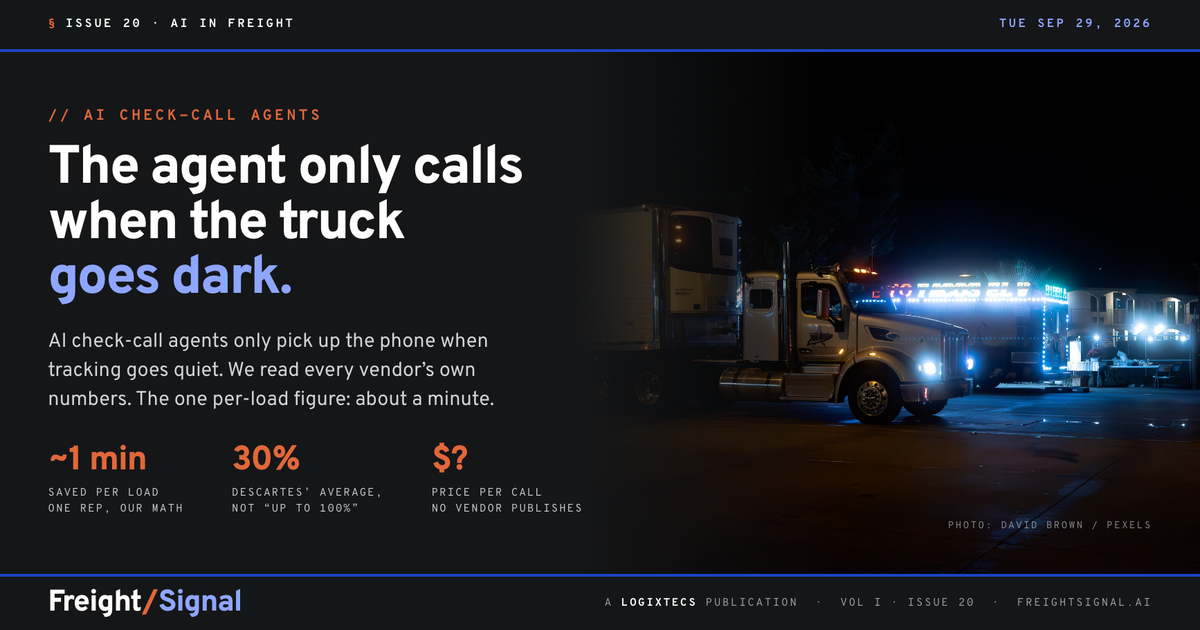
Where the minutes come fromRead the product pages closely and the best-documented agents share one design. Descartes MacroPoint’s check-call agent “calls drivers if a load is not tracking or stops tracking.” Augment’s reads the telematics first, “only reaching out when that data goes quiet.” The agent doesn’t replace every check call. It replaces the ones you make when the ELD or the app has gone dark. So the saving is two numbers multiplied: the share of your loads that go dark, and the minutes you spend chasing each one. No vendor publishes either. What the vendors publish Descartes: “up to 100%” of manual check calls; 30% more no-touch tracking on average.
NTG (Augment case study): 87% of track-and-trace volume; a third less time on status updates.
Armstrong (one rep): “more than an hour each day” across 50–70 loads — about a minute a load, our arithmetic. |
C.H. Robinson’s 350 hours a day is real, and a different job: chasing missed LTL pickups. Nobody publishes a price per call either, so no minute converts to a dollar. Two more questions before you sign. The FCC ruled in 2024 that AI voices are “artificial” under the TCPA, and such calls must identify who is calling — ask how the agent does. And ask whether it knows a driver on a 10-hour break is not a load gone dark. Our verdict on the category: WATCH — until a vendor prints minutes per call and a price. |